
Sound
Welcome to my monthly newsletter, Attunement!
Each month we “tune into” a theme related to mindfulness and
explore a creative practice and tune based on this theme!
This month of May we’re TUNING INTO the frequency of:
SOUND

Stop, close your eyes and listen. Notice all the sounds. Outside us some are pleasant (a bird singing), some unpleasant (an engine roaring); inside us some are calming (our breathing), some are disturbing (tinnitus and gurgling)[...] [become] aware of the existence of all these ambient sounds and the emotions, thoughts and impulses that they trigger in us.
-Christophe André (From the book Looking at Mindfulness)
Each sound is a pearl, a treasure, a wave that brings you back to your body.
-Michael Stone (From the book Awake in the World)
SOUND AS A MINDFULNESS TOOL
Just as we can use our breath as an anchor to the present moment (as in formal meditation practice), so can we use sound. Whenever we intentionally direct our attention to a sound in our environment, we're engaging in mindfulness.
Try this: if it's daytime and you're able to go outside for a moment, experiment with directing your attention to the various sounds you hear. For example, you might hear the sound of a lawnmower engine, of a car driving by, of the wind moving through the leaves of trees, or of birds singing. Now see if you can focus your attention on the farthest-away sound you can hear. Now focus in on the closest sound you can hear; perhaps it's the sound of your own breathing!
FEELING TONES OF SOUNDS
You may notice, as you listen, that some sounds feel pleasant to you, while others feel unpleasant. Some sounds may feel neither pleasant nor unpleasant, but rather neutral. In Buddhism, these experiential qualities are known as "feeling tones"--immediate raw qualities of an experience arising from sense contact.
PERCEPTIONS OF SOUNDS
We can also tune into (see what I did there?!) the conceptual descriptions we ascribe to the sounds we hear. For example, "that's a cardinal singing", or "that's the sound of a car horn."
Finally, we can notice any perceptions or narratives the mind creates about these sounds. For example, "I prefer chickadee song to cardinal song", or "People use their horns too much".
CLINGING/AVERSION TO SOUNDS
We can also notice the states of clinging or aversion that arise within us in response to certain sounds. For example, "I wish it could stay springtime all year long so I could enjoy sitting outside and listening to the birds", or "I wish I lived on a cul-de-sac street; too many cars drive down my street, and it's noisy."
JUST NOTICING
When we become aware of all or any of the above, we are practicing mindfulness. With this "noticing" practice, we become aware of our mind's tendency to label and judge experience. With this awareness we're then more able to respond instead of react to our experience. Furthermore, we aren't as quick to equate pleasant with good and unpleasant with bad; rather, we're able to observe experiences as simply pleasant, unpleasant, or neutral. This allows us to experience less clinging and/or aversion, which leads to less self-created suffering and more wisdom and even contentment.
SOUND BATHS: A SOUND-BASED MINDFULNESS TOOL
Sound baths are full-body listening experiences--usually featuring crystal or metallic singing bowls--in which you can experiment with any/all of the above mindfulness practices. An additional benefit of sound baths is that they allow the nervous system to down-regulate (from fight-flight-freeze-fawn to rest-and-digest); in other words, they're relaxing!
At The Be Sanctuary in Upper Arlington I offer quarterly "Social Justice Sound Baths" (in which all money received goes to support a non-profit organization doing social justice work--my next one is on May 11th, 7-8pm!, and we'll be supporting the Columbus Foundation's "Gifts of Kindness" Fund).
I have also recorded two short sound baths, "Clearing the Path" and "Riding the Tide", and they're available to listen to anywhere you stream music.
Creative Mindfulness Practice:
5 Minutes of Deep Listening
What you'll need:A timer, pen and paper
Instructions: Go outside, set a timer for 5 minutes, and listen. Note all of the sounds you hear in the space you’re in. Afterwards, jot down what you noticed, what surprised you, how the sounds affected you, and how you're feeling now. You might challenge yourself to do this practice every day for one week and see what you notice as a result!
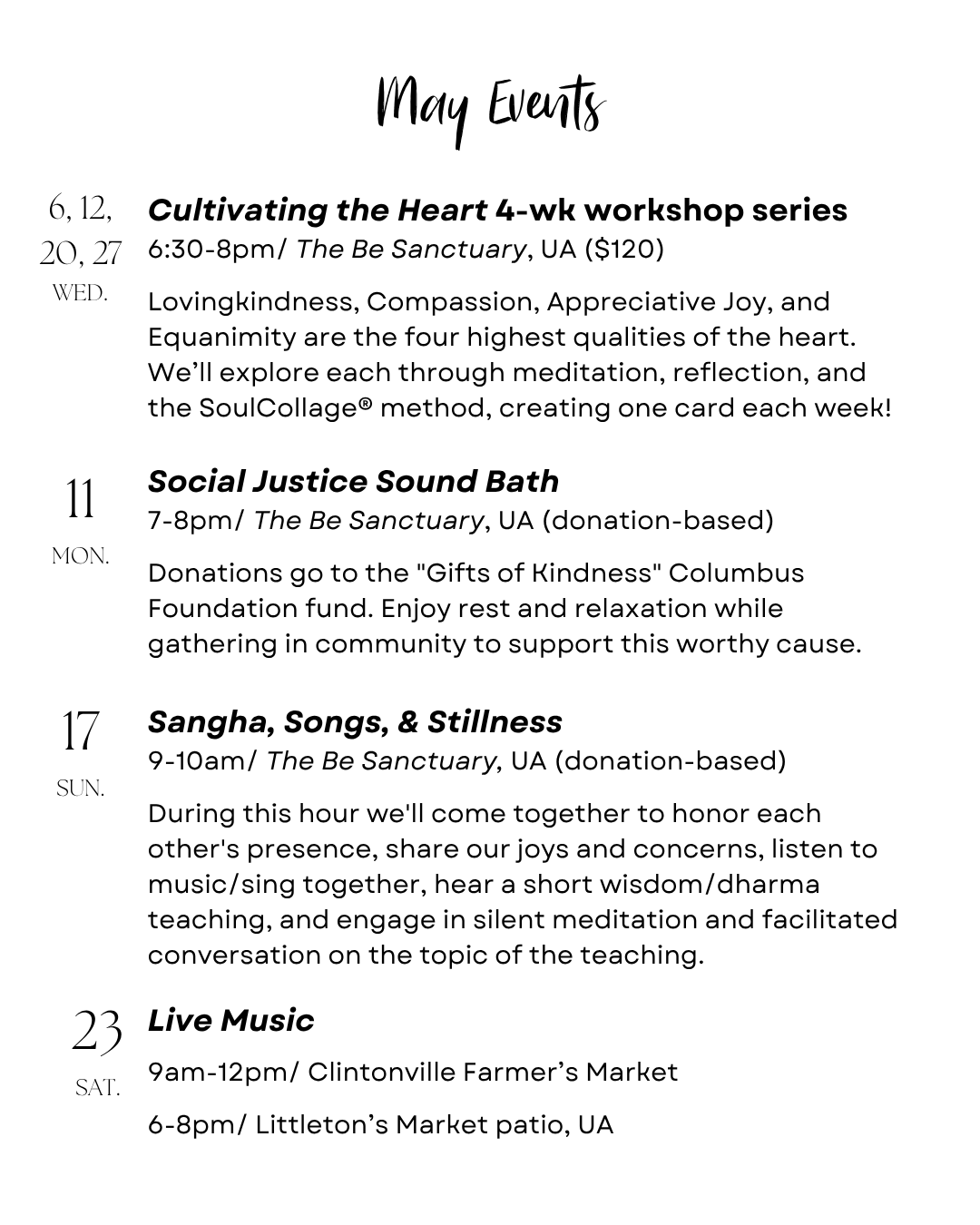
MAY Events:
This Month’s Tune 🎵:
Each month I share a tune that resonates with the newsletter theme. For May's theme of SOUND, I've chosen the classic song "The Sound of Music" from the musical and beloved movie of the same name (starring the iconic Julie Andrews!).
The hills are alive with the sound of music
With songs, they have sung for a thousand years
The hills fill my heart with the sound of music
My heart wants to sing every song it hears
My heart wants to beat like the wings of the birds that rise from the lake to the trees
My heart wants to sigh like the chime that flies from a church on a breeze
To laugh like a brook as it trips and falls over stones on its way
To sing through the night like a lark who is learning to pray
I go to the hills when my heart is lonely
I know I will hear what I've heard before
My heart will be blessed with the sound of music
And I'll sing once more