Renunciation
Welcome to my monthly newsletter, Attunement!
Each month we “tune into” a theme related to mindfulness and
explore a creative practice and tune based on this theme!
This month of October we’re TUNING INTO the frequency of:
RENUNCIATION

The soul grows through subtraction, not by addition.
-Henry David Thoreau
Circumstances change, we change, things change, and letting go of what we’re holding on to can be a great relief. It is also the road to happiness.
-James Baraz
Real renunciation is not a matter of compelling ourselves to give up things still inwardly cherished, but of changing our perspective on them so that they no longer bind us.
-Bhikkhu Bodhi
What renunciation is, and what it's not
The concept of renunciation doesn't tend to excite people ;)
In fact, most of us would say it's a synonym for deprivation. Like giving things up, white-knuckling your way through desire, living a smaller and more austere life in the name of some distant spiritual ideal. Like something monks do — not people with families, mortgages, and full email inboxes.
And yet, the Buddhist teaching on renunciation is one of the most liberating and useful teachings I've encountered. Because renunciation is not really about giving things up. Rather, it's about abandoning that which is hindering our life in everyday situations; it supports us in making intentional choices about to what we give our attention, energy, and time.
Meditation teacher Gil Fronsdal writes, "The Latin root of the word 'sacrifice' means 'to make sacred.' The Buddha did not teach renunciation as a form of denial or asceticism. Rather, he taught letting go as a way to achieve a greater good--a deeper happiness... The Buddha once said, 'If one sees that a greater happiness is found by letting go of a lesser one, the wise person will let go of the lesser happiness.' "
This "letting go" doesn't necessarily mean we have to renounce the things that contribute to our happiness, but it does mean practicing renouncing our clinging to these things.
Clinging to comfort
I like Gil Fronsdal's explanation: "Even though it doesn’t take much mindfulness to recognize that suffering comes with clinging, we often find it hard to let go of clinging-or even to see letting go as possible or worthwhile. Strong feelings of desire often come with a compulsion that makes the desire seem necessary. Or we may approach clinging like a lottery--we are willing to bear the risk of suffering in exchange for the chance that the clinging will bring us well-being. Furthermore, letting go can be frightening. Clinging may give us a sense of taking care of ourselves--holding tight to security, judgements, people, self-identity, or possessions are all ways of protecting ourselves."
Recently when a big storm/tornado blew through central Ohio, our house (like many others) lost power. We didn't get it back for three days. That's a really short time in the scheme of things, but it was long enough for me to get frustrated and impatient with the situation. I never really realize how attached I am to things like a working refrigerator, air conditioning, stove, hairdryer, charged phone, etc., until I "lose" them to a power outage like this. And reflecting back, I'm very grateful we didn't actually lose any of those things in the storm. We did get a limb through our roof, and a very big repair bill, but our possessions--and more importantly, our family--remained intact. While this "renunciation of power" (ooh, what a metaphor!) happened involuntarily, it still provided me the opportunity to reflect on my habitual tendency to cling to various types of comforts, and to practice wise surrender to what is unavoidable... after I threw a temper tantrum about it, that is! ;)
Looking mindfully at our habits
Meditation teacher Joseph Goldstein says this about our habitual tendencies and addictions (whether they be to alcohol, to social media, to shopping, to sugar, etc.): "In the moment of gratification, they do give us pleasure. But then we grasp at them, feel the lack when they change, and reach for them again and again, or we look for another source of momentary satisfaction, and then another and another, until we're totally immersed in the wanting and grasping states of mind. We become quite firmly enmeshed in the force field of our desires, usually not even suspecting that we're entrapped."
And he issues an invitation: "We might look at all our habitual actions during the day. Although we probably don't think of them as addictions, how easy would it be to let go of a strong habit?"
Here are some ways to experiment with the principles of renunciation in your daily life:
Pause before you indulge
Notice your impulses rather than automatically acting on them. This might mean scrolling less, eating only when you're actually hungry, or not reacting immediately when you're upset. As we become more aware that things change, we may naturally become less attached to getting or holding onto every experience we want.Be intentional about what you have
Pay attention to how you use your possessions, food, home, money, and especially your time and energy. Ask: Is this actually serving me? Am I using what I have in a way that reflects what matters to me?Know what to tolerate and what to walk away from
Life includes things we don't like and can't immediately change. Sometimes we need to sit with discomfort rather than escape it. Other times, the wise thing is to step away from something harmful. The practice is learning the difference.Let go of what is hurting you
Once you recognize habits, relationships, thoughts, or behaviors that aren't healthy or helpful, take steps to reduce or remove them.Make room for what helps you thrive
When we let go of what creates suffering, we create space for qualities we want to cultivate: peace, kindness, clarity, compassion, wisdom, and freedom.(Source: https://www.buddhistinquiry.org/article/renunciation-the-high-happiness/)
Renunciation on Retreat
I just returned from a 6-night Women's Silent Meditation Retreat at Spirit Rock in California.
This type of retreat experience creates a temporary container in which to step away from the usual ways of seeking stimulation, comfort, distraction, and control so we can see our minds and experience more clearly. On this retreat, my fellow participants and I practiced renouncing:
Entertainment/stimulation/comfort — time away from phones, TV, music, social media
Socializing — the majority of the retreat was spent in "noble silence"
Constant activity — the schedule was very simple, with long periods of meditation
Choice and control — meals, schedule, and activities were largely predetermined
This container of renunciation provided me many opportunities to observe my mind's tendencies towards craving, aversion, and delusion. And it also enabled me to experience firsthand the truth of impermanence: uncomfortable sensations change, emotions shift, urges pass, and no single thought or condition lasts forever.
I'm returning to the "real world" with a bit more confidence in my meditation practice, a rested nervous system, and a lot of learnings that continue to marinate in my mind and heart. I'm happy to share more with you if you have specific questions.
This month, I invite you to reflect on what renunciation might look like for you. There's no "one right way" way to play with this practice, but this month's Creative Mindfulness Practice below is one suggestion.
Creative Mindfulness Practice:
Take a “data sabbath”
What you'll need: Time away from your phone and computer
Instructions: Plan ahead for a half or whole day where you don't use your phone (for anything other than receiving/placing urgent calls) or any other type of screen. Consider this a "data sabbath" or your own personal "tech renunciation retreat".
Spend some time outside during your tech sabbath--maybe even try some walking meditation.
These are meditation teacher Ajahn Amaro's instructions: "Allow yourself to actually be present, to feel the earth under your feet, to feel your breath and the world that you’re in rather than being in a constant state of electronic communication with others."

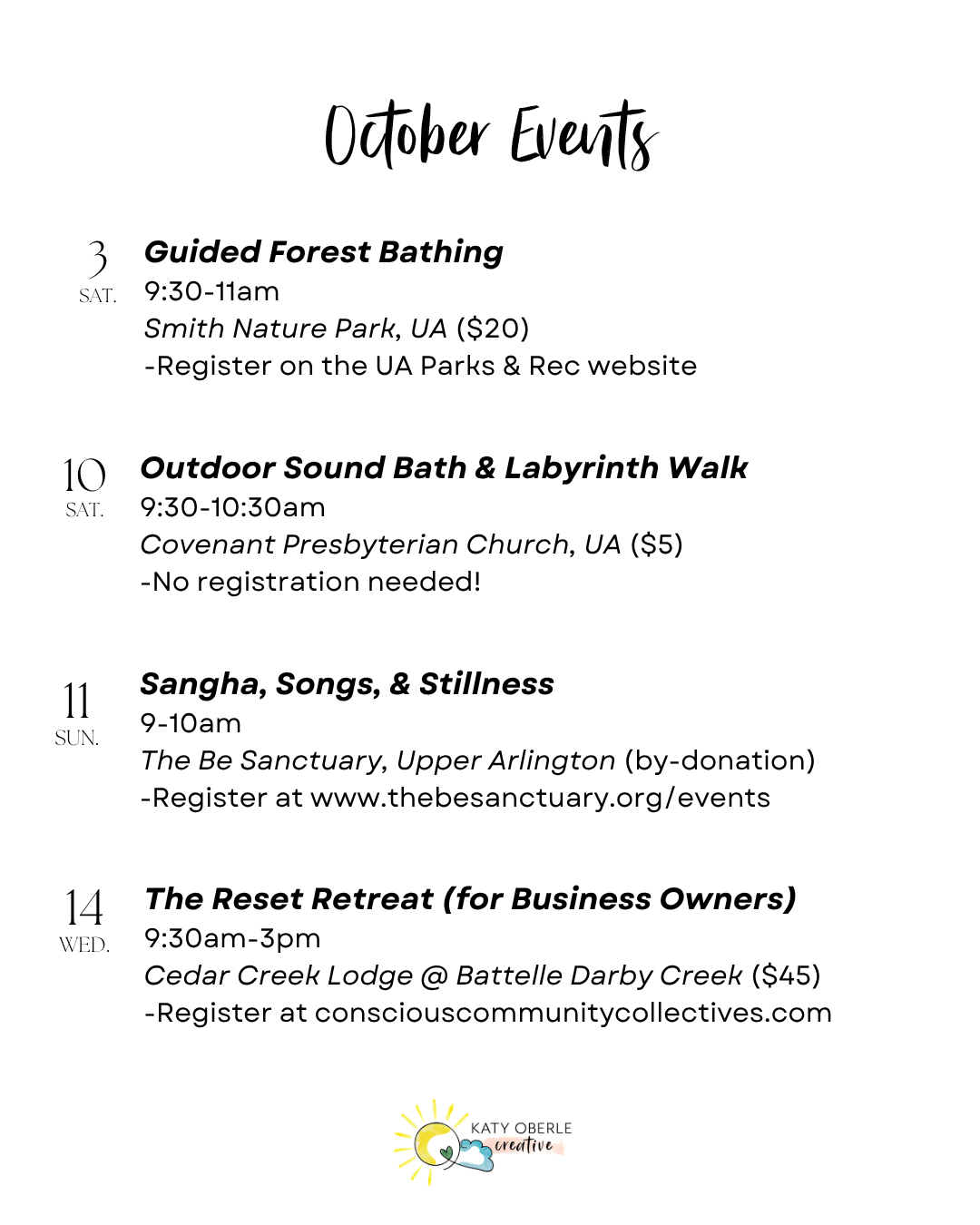
OCTOBER Events:
This Month’s Tune 🎵:
Each month I share a tune that resonates with the newsletter theme.
For this month's theme of RENUNCTIATION, I've chosen the song "Doesn't It Feel Good" by Lisa Loeb.
I invite you to consider the lyrics and reflect on your relationship to your habits. Are you clinging to certain people/behaviors/things/places in the hopes they'll make you feel good/happy/fulfilled? Perhaps "walking away" doesn't have to be literal; it can simply mean stepping back, creating some space, and gaining enough perspective to discern whether you’re in right relationship with these people, behaviors, things, or places.
Buddhist nun Sister Siripañña says this about the power of discernment:
"You really have got two choices: you can want to do it and do it, or you can want to do it and not do it. But don’t want to do it, do it, and then feel guilty about it. Do one or the other, do it totally, and determine to learn from it. If you are caught by guilt and judgement and self-hatred because you think you shouldn’t be doing it, then there’s no opportunity for understanding. That’s a very contracted mind-state; it can’t reflect. We have to be clear enough and compassionate enough to allow ourselves to indulge sometimes—but really watch the effect. Be clear enough to notice how you feel. Does it feel as good as you thought? Was it worth it? What are the consequences to yourself and to others? The restraint of mindfulness leads to understanding, and understanding leads to peace."
Wishing you a peaceful October.
❤️, Katy