Wonder & Awe
Welcome to my monthly newsletter, Attunement!
Each month we “tune into” a theme related to mindfulness and
explore a creative practice and tune based on this theme!
This month of July we’re TUNING INTO the frequency of:
WONDER & AWE

Wisdom begins in wonder.
-Socrates
Psychologists describe awe as the feeling we experience when encountering something so vast, beautiful, or unexpected that it shifts our perspective and expands our sense of what's possible. Wonder is closely related; it's the sense of curiosity, fascination, and openness that invites us to slow down and pay attention.
Research* suggests that experiences of awe and wonder can help reduce stress, improve mood, spark creativity and joy, and strengthen our sense of connection with others. They remind us that we're part of something larger than ourselves and encourage us to interact with with a beginner's mind and with reverence for the miraculous and for the ordinary--which can itself become miraculous when viewed with mindful eyes).
Like mindfulness, wonder and awe are trainable qualities.
The challenge is that our brains are wired for efficiency, so we habituate to our environment and operate on autopilot much of the time. Travel can be really helpful for this reason; in novel (new) surroundings, awe and wonder can be easier to tap into.
However, by slowing down and paying attention with curiosity wherever we are--even in the familiarity of our backyard or when going about our normal routines--we dismantle the "autopilot barrier" to awe and wonder. For example, we can notice:
The complexity of birdsong.
The intricate patterns in a leaf.
The scent of a flower.
The emotion in a piece of music.
A stranger's small act of kindness.
The miracle that a loved one exists at all.
Wonder and awe can be easier to access when we cultivate these mindful attitudes/ practices:
1) Beginner's Mind
Instead of assuming we already know something, we approach it as if seeing it for the first time.
2) Presence
Awe can only happen in the present moment. If we're lost in worry, planning, or distraction, we often miss the experiences that might have moved us.
3) Savoring
When something beautiful, meaningful, or inspiring happens, mindfulness helps us linger with it long enough for it to register in our minds and bodies.
Dacher Keltner, author of the book Awe: The New Science of Everyday Wonder and How It Can Transform Your Life, writes:
Wonder, the mental state of openness, questioning, curiosity, and embracing mystery, arises out of experiences of awe. In our studies, people who find more everyday awe show evidence of living with wonder. They are more open to new ideas. To what is unknown. To what language can’t describe. To the absurd. To seeking new knowledge. To experience itself, for example of sound, or color, or bodily sensation, or the directions thought might take during dreams or meditation. To the strengths and virtues of other people. It should not surprise that people who feel even five minutes a day of everyday awe are more curious about art, music, poetry, new scientific discoveries, philosophy, and questions about life and death. They feel more comfortable with mysteries, with that which cannot be explained.
What spurred me to choose WONDER & AWE as this month's newsletter theme was listening to Lisa Loeb's song "Wonder" (scroll down to the end of this email to watch the music video/listen to the song). Here are the lyrics:
If you just look all around you, you might start to see
That everything is magical and full of mystery
It has always been there, it's just sometimes hard to see
You have to use more than your eyes, and soon you will believe
Don't have to imagine it, it's above and below
It's things you've never seen before, and things you've always known
If you just look around you, you might start to see
That everything is possible, it's up to us to see
That there's so much wonder in the world
Waiting for you to find
Creative Mindfulness Practice:
Awe Walk
What you'll need: 15 minutes to go outside
Instructions:
Go for a short walk outside. During the walk, see if you can, as Dacher Keltner says, "tap into your childlike sense of wonder, imagining you’re seeing everything for the first time. Take a moment during each walk to notice the vastness of things—when looking at a panoramic view, for example, or at the detail of a flower."*
*Read about the research on awe walks here.
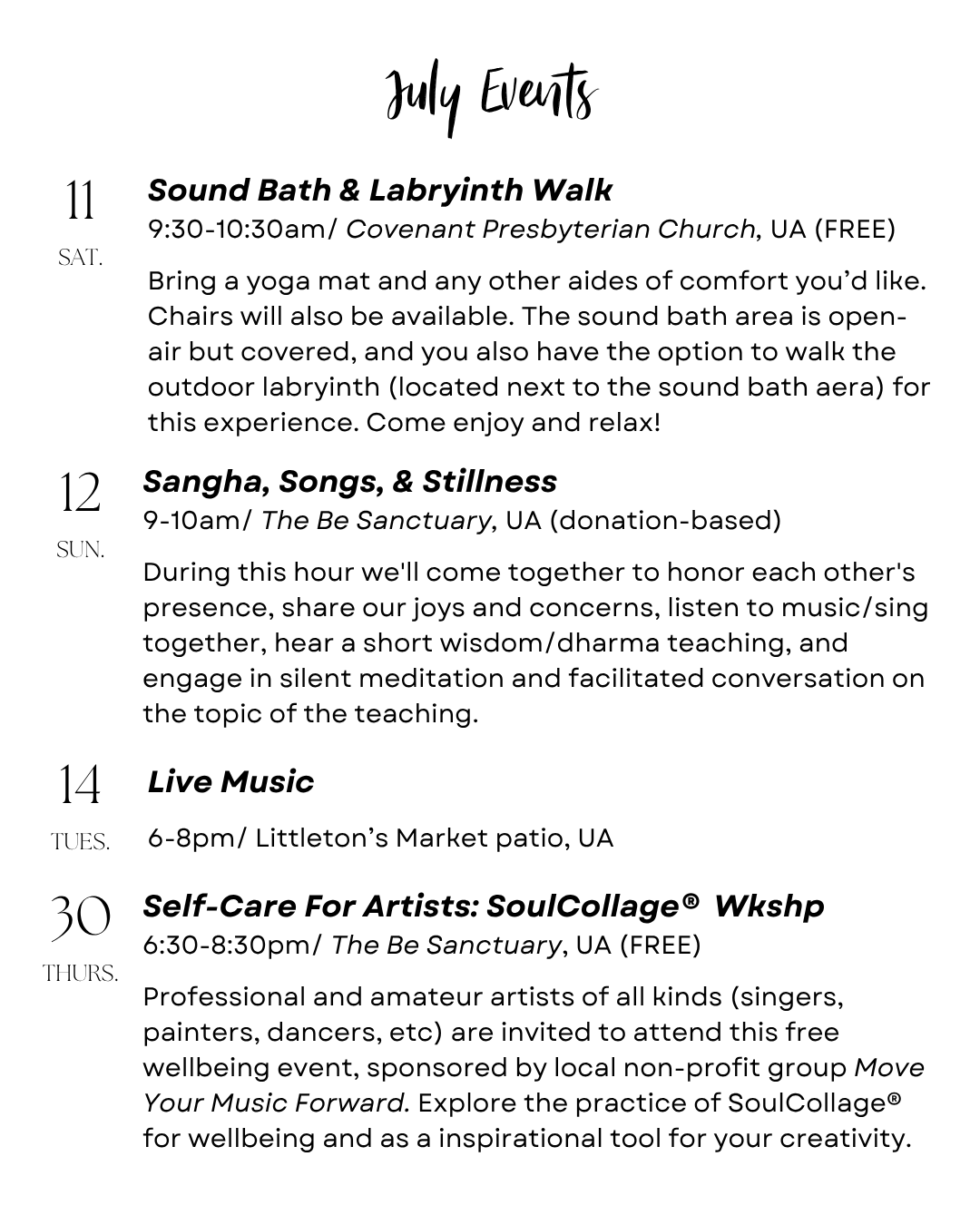
JULYEvents:
This Month’s Tune 🎵:
Each month I share a tune that resonates with the newsletter theme. For May's theme of WONDER & AWE, I've chosen the song "Wonder" by Lisa Loeb. Watch/listen to the music "/video" here.
Wishing you a wonderous July!